Why SQL Is the One Non-Negotiable Skill for Every Data Analyst (and Every Data Enthusiast)
Every roadmap, every job posting, every hiring manager, every "how I broke into data" story circles back to the same three letters. Here's why SQL isn't optional — it's the entry fee.
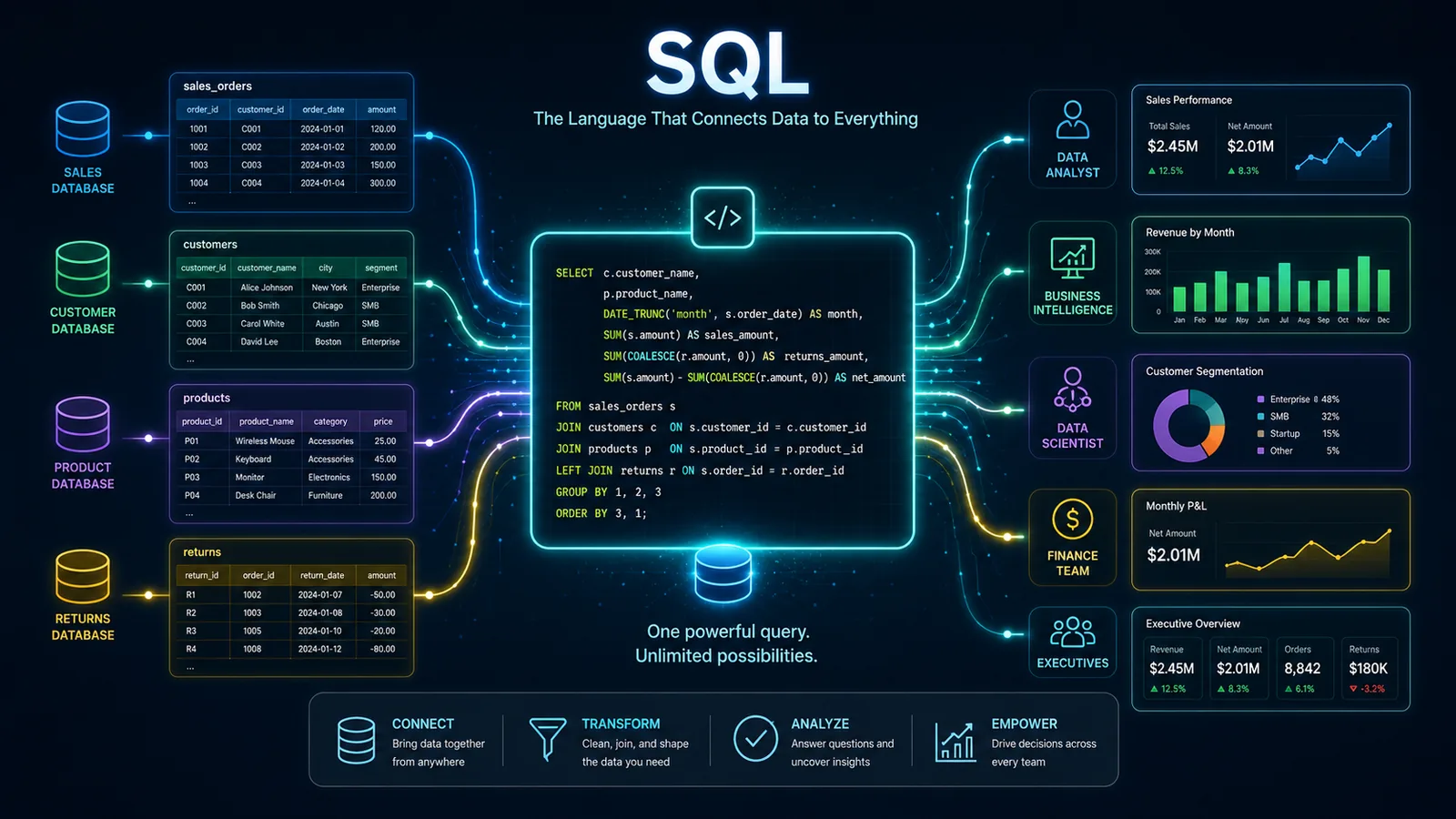
If you spend any time researching data careers, you'll notice something strange: people argue endlessly about Python vs. R, Power BI vs. Tableau, and whether you really need a master's degree to call yourself a data scientist. But there's one skill that almost nobody argues about. Every roadmap, every job posting, every hiring manager, every "how I broke into data" story circles back to the same three letters: SQL.
That's not an accident, and it's not a trend that's going to fade out next year. SQL has been the backbone of how organizations store, organize, and retrieve data for over five decades, and despite wave after wave of new tools, frameworks, and AI-powered assistants, it has never been displaced. If anything, it's become more important, not less, as companies drown in more data than ever before.
This article is about why SQL specifically matters so much for data analysts, and why — if you're serious about a career in data in any capacity — it's not really optional. It's the entry fee.
What SQL Actually Is (For Anyone Who's Never Touched It)
SQL stands for Structured Query Language. It's the language used to talk to relational databases — the systems that store structured data in tables, rows, and columns, the same way a well-organized spreadsheet does, except built to handle millions or billions of rows without breaking a sweat.
When a company wants to know how many orders came in last quarter, which customers churned, or what the average transaction value was in a particular region, that information almost always lives inside a database. SQL is how you ask that database a question and get an answer back.
A basic SQL query might look like this:
SELECT region, COUNT(*) AS total_orders, AVG(order_value) AS avg_order_value
FROM orders
WHERE order_date >= '2026-01-01'
GROUP BY region
ORDER BY total_orders DESC;
Read that out loud and it almost sounds like plain English — because that's intentional. SQL was designed in the 1970s specifically to be readable by people who weren't professional programmers. That's part of why it has survived so long: it strikes a rare balance between being powerful enough for engineers and approachable enough for analysts, marketers, and business teams to pick up.
The Data Analyst's Job, Stripped Down to Its Core
Before getting into why SQL matters so much, it's worth being honest about what a data analyst's job actually looks like day to day, because that's where the "why" becomes obvious.
A data analyst spends most of their time answering business questions using existing data. Someone in leadership asks, "Why did signups drop last month?" or "Which product line has the healthiest margins?" or "Are we losing customers faster in one city than another?" Those questions don't come with the data already pulled and organized — they come with a database somewhere, full of raw tables, and it's the analyst's job to go get the answer.
That retrieval step — reaching into a database, pulling exactly the data you need, shaping it, filtering it, and summarizing it — is almost always done in SQL. Everything downstream of that, the charts, the dashboards, the presentation to a VP, depends entirely on getting that first step right. If you can't query the data, you can't do the job. It's really that direct.
SQL Is How You Actually Get the Data in the First Place
This sounds almost too obvious to state, but it's the reason everything else on this list matters. You cannot analyze data you cannot access. Excel, Power BI, Tableau, Python, and every other tool in an analyst's toolkit are all designed to work with data — they assume the data has already arrived, cleaned and structured, ready to be visualized or modeled.
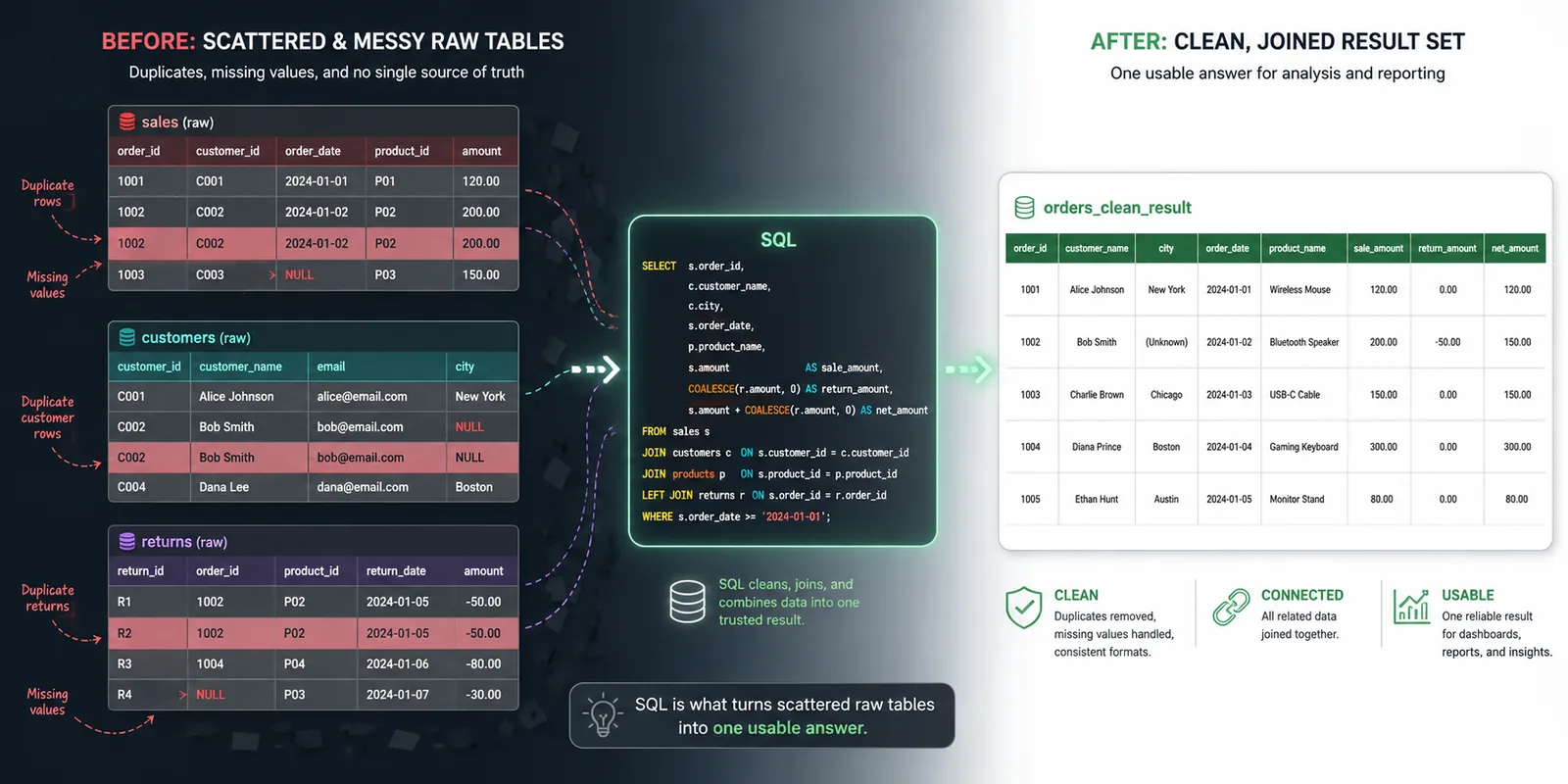
But data doesn't start out that way. It starts out sitting across dozens or hundreds of tables inside a company's database systems — a sales table here, a customer table there, a returns table somewhere else, each with its own quirks, its own duplicate records, its own missing values. SQL is the tool that goes in, joins those tables together correctly, filters out the noise, and pulls out exactly the slice of data relevant to the question being asked.
Skip SQL, and you're stuck waiting on someone else — usually an engineer with a much longer to-do list than yours — to hand you a clean CSV export whenever you need one. That's a slow, dependent, frustrating way to work, and it's precisely the bottleneck that makes SQL-literate analysts so much more valuable than analysts who can only work inside spreadsheets someone else prepared for them.
It's the Common Language of Every Data Role, Not Just Analysts
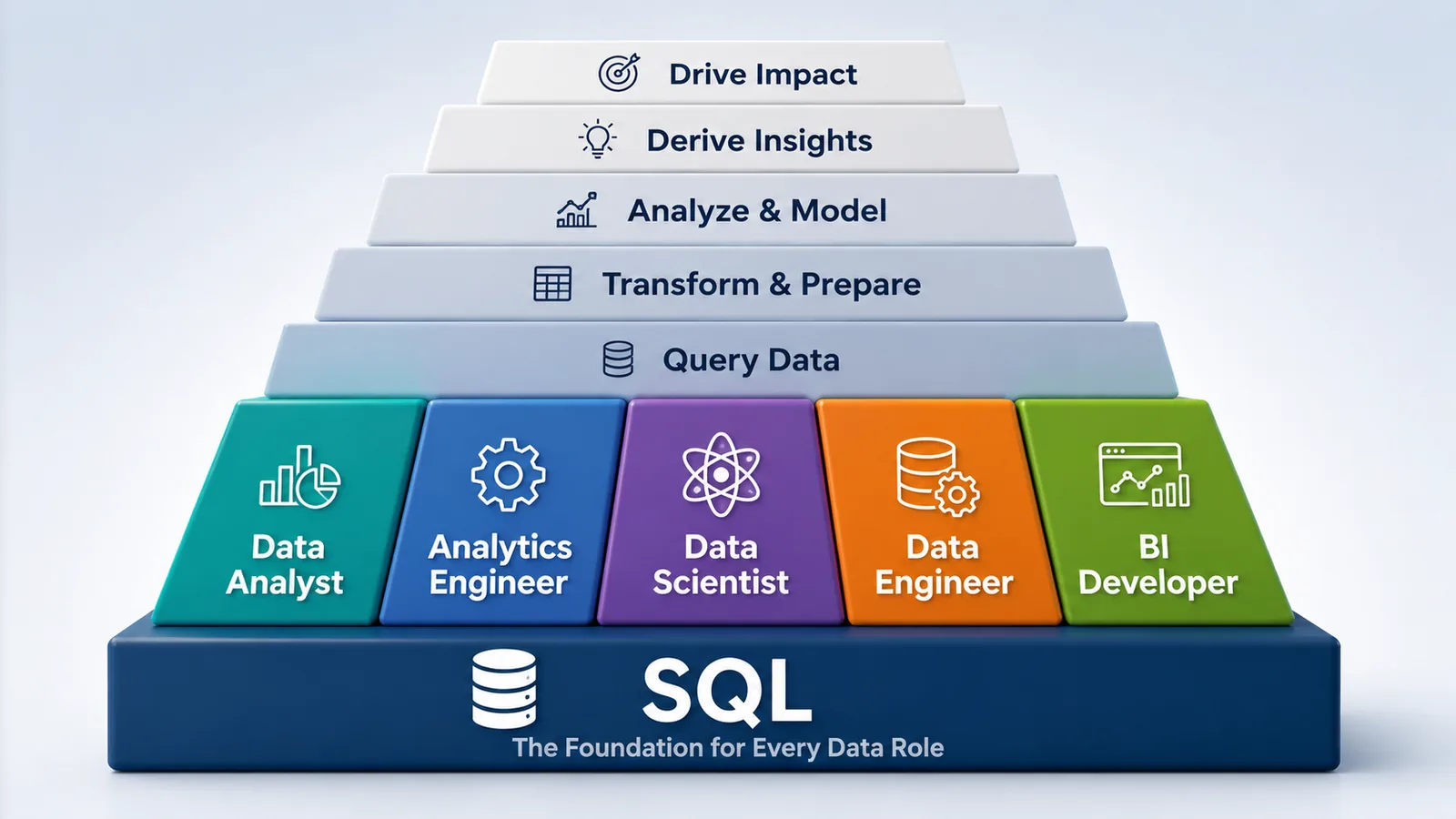
One of the clearer patterns in how data teams are structured today is that SQL sits underneath almost every role in the pipeline, not just the analyst seat. Data engineers use deeper, more advanced SQL to build and maintain pipelines. Analytics engineers use SQL, often paired with a tool like dbt, to transform raw data into clean, well-modeled datasets. Data scientists use SQL constantly to pull and prepare data before a single machine learning model gets trained. Business intelligence developers use SQL to power the dashboards an entire company checks every morning.
This matters for two reasons. First, it means learning SQL well isn't a narrow, role-specific investment — it's foundational infrastructure that pays off no matter which direction your data career eventually bends toward. Second, it means SQL fluency is what lets you actually communicate with the rest of a data team. When an analyst can read and reason about the same queries an engineer writes, collaboration gets dramatically easier. When they can't, every request turns into a translation exercise, and translation exercises are where projects slow down.
If you look at how people actually move through data careers — starting as an analyst and growing into analytics engineering, data science, or even data engineering over time — SQL is the one skill that carries forward unchanged at every step. Everything else you'll add along the way (Python, statistics, cloud platforms, machine learning) builds on top of SQL. Almost nothing replaces it.
SQL Scales in a Way Spreadsheets Never Will
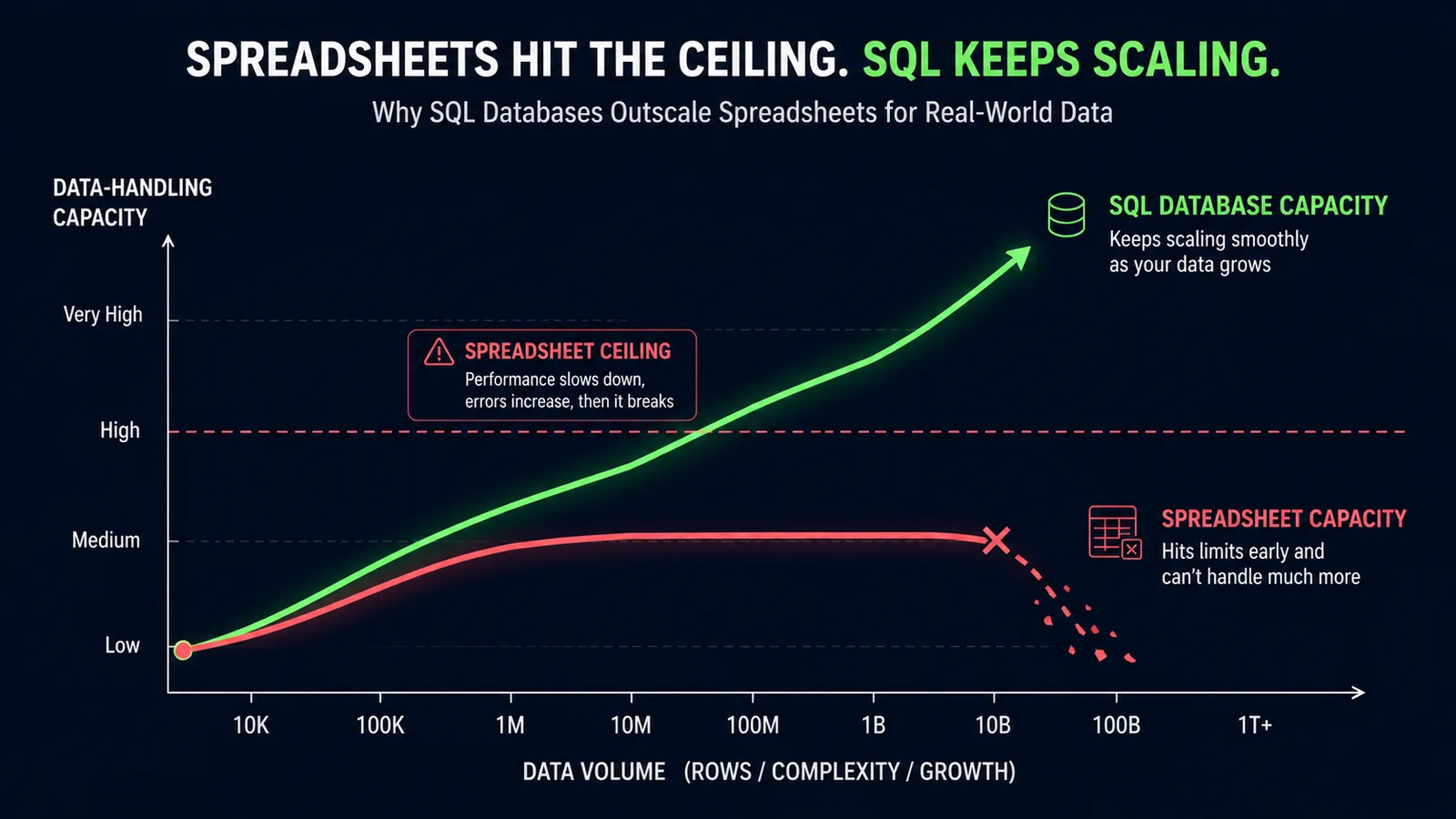
Excel is a genuinely good tool, and no honest article about data work should pretend otherwise — it's flexible, visual, and forgiving for small datasets. But Excel starts to strain the moment a dataset crosses a few hundred thousand rows, and it effectively breaks down entirely once you're dealing with millions of records, multiple related tables, or data that needs to be refreshed and re-queried on a recurring basis.
SQL databases are built for exactly that scale. A well-written SQL query can filter, join, and summarize hundreds of millions of rows in seconds, running on infrastructure designed specifically for that kind of load. As companies collect more data every year — which they reliably do — the gap between what a spreadsheet can handle and what a modern business actually generates keeps widening. Analysts who rely solely on spreadsheet tools eventually hit a hard ceiling on what kinds of problems they're able to tackle. Analysts who know SQL don't hit that ceiling at all; they just write a more targeted query.
It's the Single Most Repeated Requirement in Every Data Job Posting
If you pull up ten data analyst job listings right now, side by side, you'll notice something: they might disagree on whether you need a degree, whether Python is required, or which BI tool the company prefers — but SQL will be on every single one of them, almost without exception. It's the one truly universal line item.
This lines up with how people who've spent years inside the data hiring world talk about it. In one detailed breakdown of data career paths for 2026, SQL was described as "genuinely non-negotiable" for data analysts — and, more broadly, as the one skill that's non-negotiable across literally every role in the data field, from analysts through data engineers, analytics engineers, and data scientists. That same guide flagged underestimating SQL as one of the most common and costly mistakes career switchers make when trying to break into the field — not because SQL is exotic or hard to access, but because people assume a flashier skill like Python or machine learning will impress hiring managers more, when in practice a shaky grasp of SQL is one of the fastest ways to get filtered out of an interview process entirely. (You can read that full breakdown of data roles in Breaking Into Data: A Career Switcher's Guide to Every Path.)
The practical takeaway is simple: recruiters and hiring managers use SQL as a baseline filter. Weak SQL skills are one of the fastest ways to get screened out before you even reach a human conversation, no matter how strong the rest of your resume looks.
SQL Interview Rounds Are Now Standard — and Unforgiving
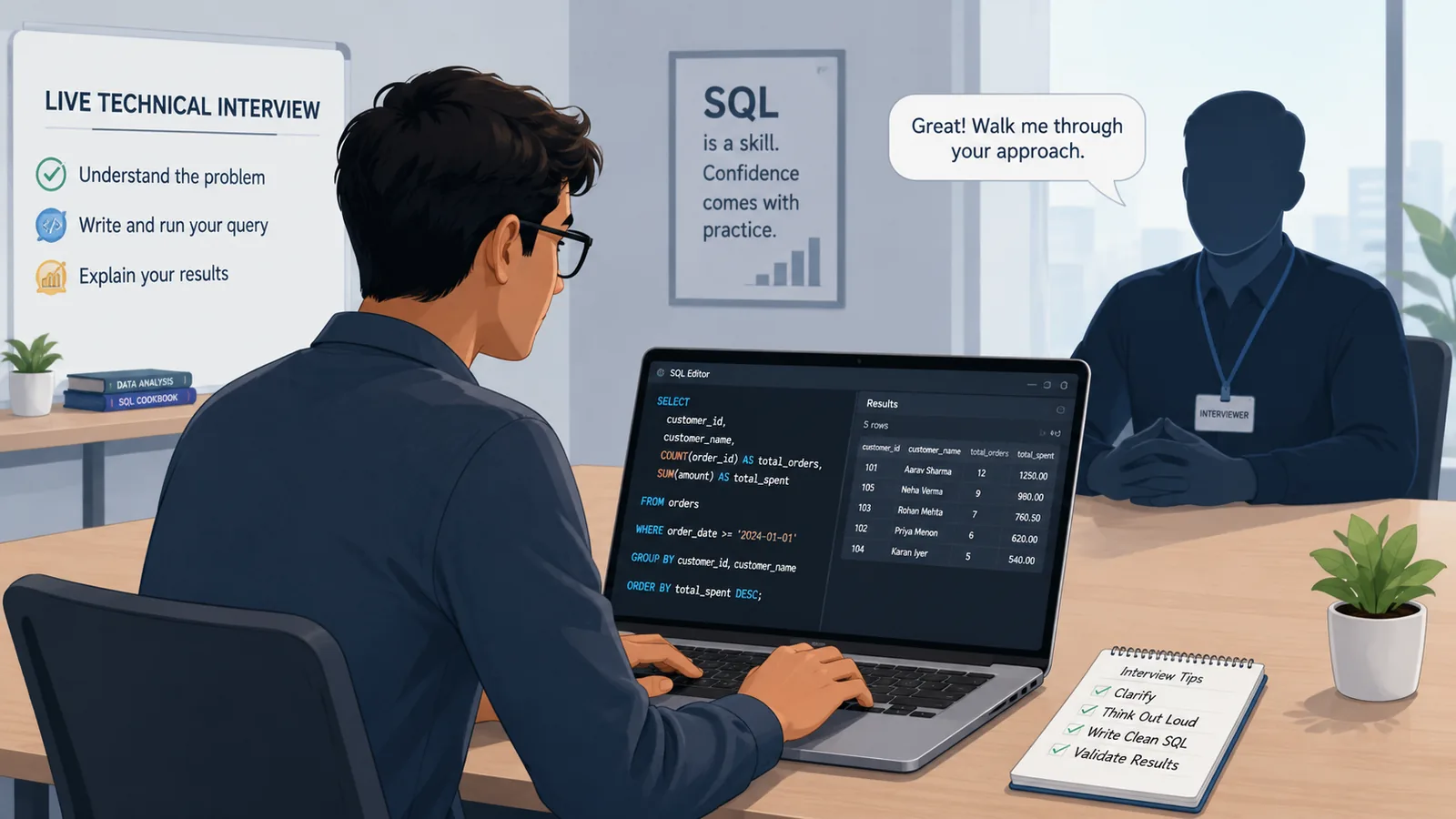
It's not just job postings. Technical interviews for data analyst roles overwhelmingly include a live or take-home SQL assessment, often before any conversation about tools, portfolio, or past projects even happens. You'll typically be asked to write queries involving joins across multiple tables, aggregate functions, subqueries, and increasingly, window functions — a more advanced SQL feature used for things like running totals, rankings, and period-over-period comparisons.
This is where a lot of self-taught analysts get caught off guard. It's common to learn just enough SQL to write a SELECT statement with a WHERE clause and assume that's "knowing SQL." In reality, that's the equivalent of knowing how to spell a handful of words and calling yourself fluent in a language. Real proficiency — the kind interviewers are actually testing for — means being comfortable with:
- Joins (inner, left, right, full) to combine data spread across multiple tables
- Aggregate functions (
COUNT,SUM,AVG,MIN,MAX) paired withGROUP BYto summarize data - Subqueries and CTEs (Common Table Expressions) to break complex logic into readable steps
- Window functions (
ROW_NUMBER(),RANK(),LAG(),LEAD()) for comparisons across rows without collapsing the dataset - Filtering logic using
WHERE,HAVING, and conditional statements that actually match the business question being asked
None of this is exotic knowledge locked behind an expensive course. It's all learnable for free, through practice, over a matter of weeks — which is exactly why interviewers lean on it so heavily. It's one of the few technical skills where the gap between "claims to know it" and "can actually demonstrate it live" shows up immediately.
SQL Teaches You to Think Like an Analyst, Not Just Use Tools Like One
There's a deeper reason SQL matters that goes beyond employability. Learning SQL well changes how you think about data.
Writing a good SQL query forces you to be precise about exactly what question you're asking. You have to decide: What am I filtering on, and why? Should this be an inner join or a left join, and what happens to my numbers if I get that wrong? Am I grouping by the right column, or am I about to accidentally double-count something? These aren't just syntax decisions — they're analytical decisions, and wrestling with them repeatedly is what builds the instinct that separates analysts who produce trustworthy numbers from analysts who produce numbers that look right but quietly aren't.
This is part of why SQL fluency tends to correlate so strongly with overall analytical maturity. It's not that SQL itself is magic — it's that the discipline of writing correct, deliberate queries against real, messy data trains a kind of rigor that carries over into every other part of the job: how you interpret a chart, how you sanity-check a dashboard number that looks suspiciously high, how you explain a finding to someone who's going to make a decision based on what you tell them.
AI Tools Haven't Replaced SQL — They've Made It Even More Valuable
It would be reasonable to wonder, given how far AI coding assistants have come, whether SQL is becoming less important because a chatbot can now generate a query for you. In practice, the opposite has happened.
AI tools are genuinely useful for speeding up SQL writing — drafting a first pass at a query, suggesting a join you hadn't considered, or cleaning up syntax. But they don't remove the need to understand SQL; they raise the bar on what you're expected to do with that time you saved. Someone who doesn't understand SQL has no way to verify whether an AI-generated query is actually correct, whether it's silently duplicating rows through a bad join, or whether it's answering a subtly different question than the one that was actually asked. Trusting a wrong query without noticing is often worse than not having the query at all, because it produces confident-looking, wrong answers that get presented to decision-makers as fact.
That's a distinction that matters enormously for anyone building a data career right now.
It's the Fastest, Cheapest Skill to Actually Prove You Have
Compare SQL to something like machine learning. Claiming machine learning expertise on a resume is easy; proving it convincingly, in a short interview window, is genuinely hard — it often requires walking through a real project, a modeling process, evaluation metrics, and trade-offs, which takes time and context most interviews don't have room for.
SQL is the opposite. It's one of the fastest technical skills to demonstrate convincingly. A hiring manager can hand you a two-table schema and a business question, watch you write a query live, and know within minutes whether you're the real thing. That's exactly why it's used as a first-round filter so often — it's efficient for employers and, frankly, it's an efficient way for you to stand out too. Unlike a lot of trendier data skills, there's no ambiguity in whether a SQL query works. It either returns the correct result or it doesn't.
This also makes it one of the best skills to invest in if you're short on time or resources. You don't need an expensive bootcamp, a GPU, or a cloud subscription to get world-class at SQL. You need a free interactive tutorial, a public dataset, and consistent practice.
Why It's Mandatory for Every Data Enthusiast, Not Just Working Analysts
Everything above focuses on data analysts specifically, but the case for SQL gets even broader once you zoom out to anyone with a general interest in data — students, career switchers, hobbyists, or people in adjacent fields like marketing, product, or operations who just want to be more data-literate.
it's the shared foundation
Whether someone eventually ends up as a data engineer, a data scientist, an analytics engineer, or a BI developer, SQL is the one skill that shows up in all of those paths without exception. Starting with SQL doesn't lock you into a narrow lane — it keeps every door open, because it's genuinely foundational rather than role-specific.
lowest-friction way to start
A lot of data learning happens in the abstract — watching videos, reading theory, collecting course certificates that never quite turn into tangible skill. SQL breaks that pattern almost immediately, because you can't really "watch" your way to being good at it. You write a query, you run it, and you either get the right answer or you don't. That fast, honest feedback loop is exactly what makes it such an effective starting point for anyone genuinely trying to build skill rather than just collect credentials.
transfers directly to your day job
If you work in marketing, SQL lets you pull your own campaign data instead of waiting on an analyst. If you work in operations, it lets you investigate inventory or fulfillment questions yourself. If you work in finance, it lets you dig into transaction-level data instead of relying entirely on pre-built reports. This is a big part of why people switching careers into data so often find their previous industry experience becomes a genuine advantage rather than a liability, once SQL gives them a way to apply that domain knowledge directly to real data.
builds real confidence, not just familiarity
There's a meaningful difference between knowing how to click through a dashboard someone else built and knowing how to go get the answer to a question nobody's built a dashboard for yet. SQL is what closes that gap. Once you can write your own queries, you stop being dependent on whatever pre-built reports happen to exist, and you start being able to actually investigate.
A Realistic Way to Actually Learn It
If any of this has convinced you it's time to actually sit down and learn SQL properly, here's a straightforward approach that avoids the two most common failure modes — never starting, and endlessly "learning" without ever practicing on real problems.
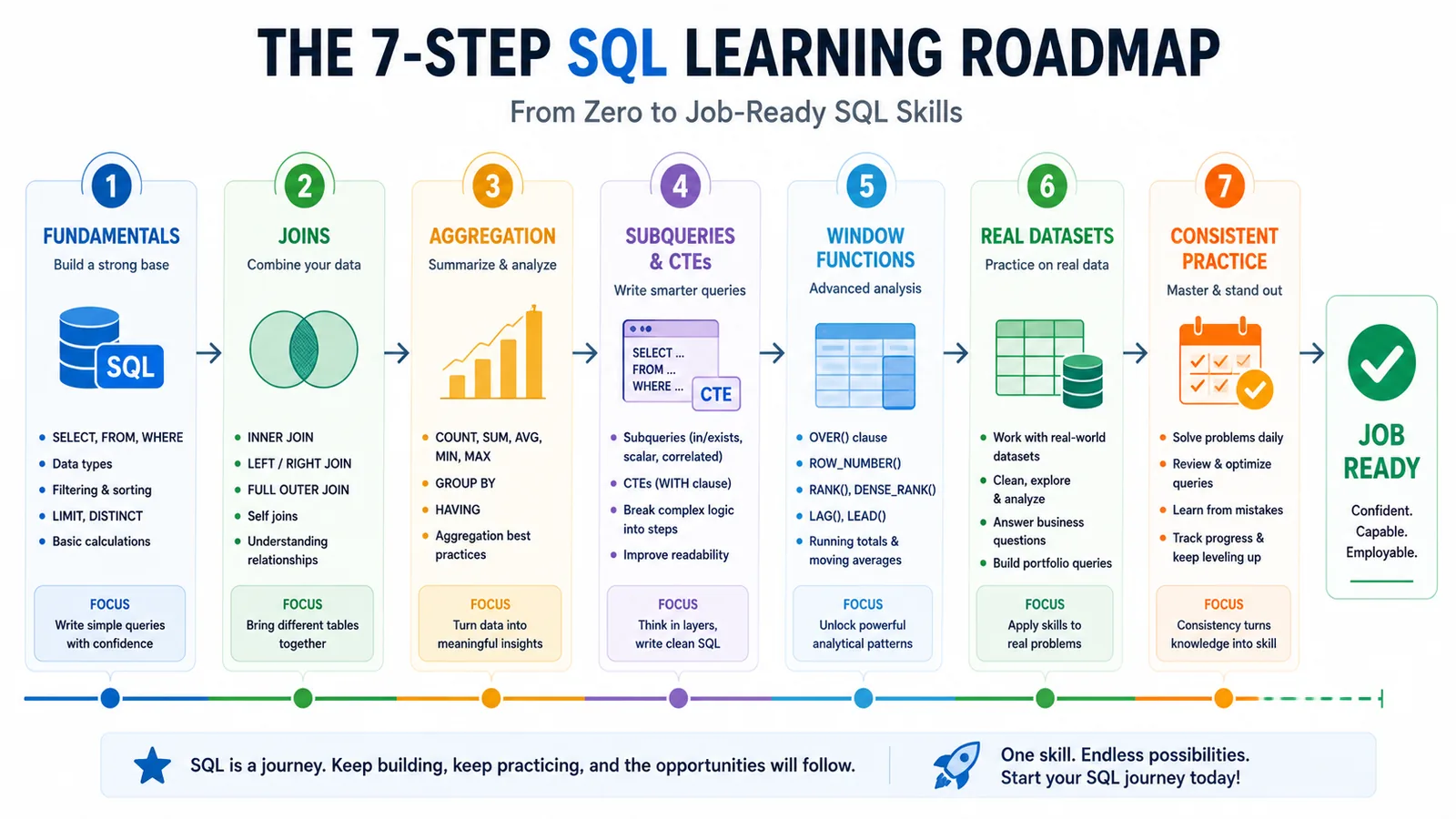
Start with the fundamentals, properly. SELECT, WHERE, ORDER BY, and basic filtering first. Don't rush past this stage even if it feels slow — it's the foundation everything else sits on.
Move into joins early, not late. Joins are where SQL starts feeling genuinely powerful, and they're also where most beginners get stuck. Push through this stage deliberately; it's the single biggest unlock in the whole learning process.
Learn aggregation and grouping. COUNT, SUM, AVG, and GROUP BY are what let you go from looking at individual rows to producing actual summarized insights — which is most of what an analyst's job actually is.
Add subqueries and CTEs. These let you break complicated, multi-step questions into clean, readable pieces instead of one unreadable wall of a query.
Finish with window functions. These are what separate a beginner from someone genuinely comfortable with SQL, and they show up constantly in real analyst work and technical interviews alike.
Practice on real, messy datasets — not just tutorial examples. Tutorial data is clean by design. Real data has duplicates, inconsistent formatting, and missing values. Practicing on messy public datasets is what actually prepares you for the job.
Do it consistently, not intensively. A focused 30–45 minutes a day, several days a week, will get you further than an occasional weekend binge followed by weeks of nothing. SQL is a skill built through repetition, the same way a language is.
Free places to actually start
- Mode Analytics SQL Tutorial — interactive, built around real analyst workflows
- SQLBolt — free, interactive, no fluff
- StrataScratch — real SQL interview questions from real companies
- Kaggle datasets — free, messy, real-world tables to practice joins and aggregation on
The Bottom Line
Tools come and go. Dashboards get redesigned, BI platforms fall in and out of favor, and even entirely new data roles keep emerging as the field evolves. But underneath all of that constant change sits one quiet, stable fact: almost all of the world's structured data still lives in relational databases, and SQL is still how you talk to them.
For a data analyst, that makes SQL less like "a skill on the resume" and more like the actual job description, condensed into three letters. For anyone with a broader interest in data — whoever you are, wherever you're starting from — it's the single highest-leverage skill you can learn first, because it's the one piece of the puzzle that every other data skill eventually needs to lean on.
If you only have time to master one thing before calling yourself data-literate, make it this one. Everything else in this field gets easier once SQL stops being the thing standing between you and the data.
— This article is part of an ongoing skills series on techedge.in. Questions about where to start? Drop a comment, I read every one.
One email, every other week.
New posts on data engineering, applied AI, and the business decisions around them. No noise, unsubscribe anytime.
Comments
All comments are reviewed before they appear publicly — this keeps spam out.
Loading comments…